
WTO meeting in Cameroon signals the rise of a ‘world minus one’ order
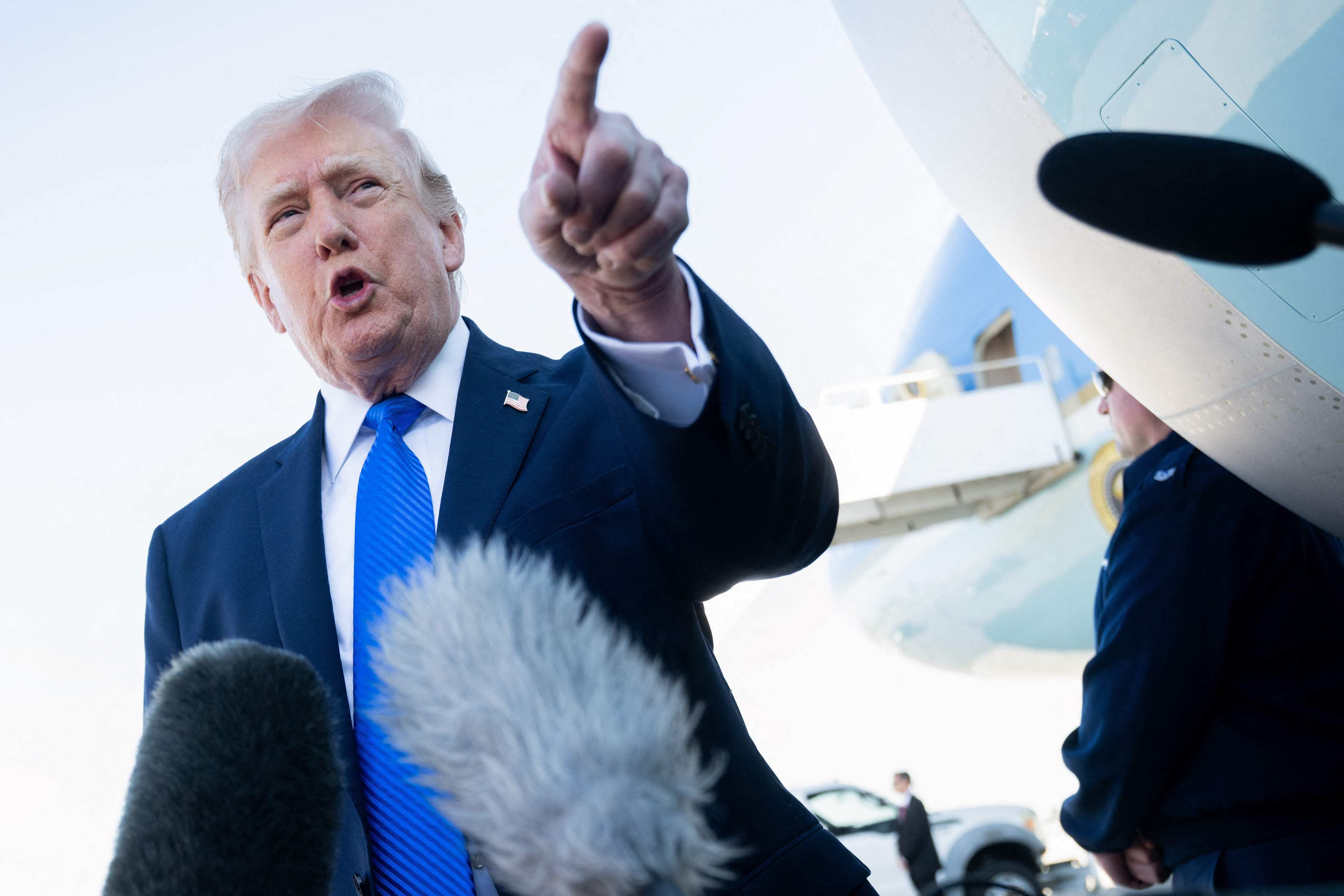
US President Donald Trump speaks to reporters before boarding Air Force One at Palm Beach International Airport in West Palm Beach, Florida, on March 23.
Photo: AFP In these turbulent times, focusing on the World Trade Organization’s 14th ministerial conference (MC14) in Yaounde, Cameroon, is a bit like trying to focus on a picnic sitting alongside a bar brawl, or listening to a lesson in pruning bonsai while a lumberjack takes a chainsaw to a giant redwood.
But try we must.
Even if the deliverables are meagre and may take years to materialise, the symbolism of Yaounde points to a possible future very different from today’s chaotic hegemonic unilateralism – with multilateral cooperation restored to relevance, Africa a significant economic force and China an anchor of soft power.
It reflects the steady, quiet shift in global economic power over three decades that is set to accelerate.
More than 100 trade ministers have gathered in Central Africa for the biennial conference but the prospect of any meaningful outcome is bleak.
Instead of a consensus declaration, there will be a minimalist draft outlining potential work plans.
Much of the discussion will be on WTO reform.
US ambassador to the WTO Joseph Barloon said: “We have to be honest with ourselves: the discussions are not sufficiently mature to allow for a workplan that concretely and with specificity defines the work going forward.” But Barloon would say that of course.
It is the United States that has spent much of the past few years attacking WTO’s foundations and the principles of multilateral cooperation it represents.
President Donald Trump’s unilateralism, castration of the WTO’s trade dispute settlement process and abandonment of the core principle of most-favoured nation trading status – which requires economies to extend trade rules even-handedly to all trading partners – are pushing the WTO into irrelevance.
In this respect, the Yaounde meeting is an act of defiance.
It asserts that most nations still value and prefer multilateral cooperation over the chaotic whims of a hegemon.
It also symbolises a changing world economy, a rising Africa and China’s growing influence worldwide.
Cameroon is hardly an epicentre of world trade.
While it boasts the world’s oldest head of state – President Paul Biya, 93, came to power in 1982 – it sits precariously close to Africa’s “coup belt”, a string of eight nations lying west to east across the continent that have suffered coups since 2020.
T
原文链接: 南华早报