
German defence minister urges strong US presence in Indo-Pacific amid China concerns
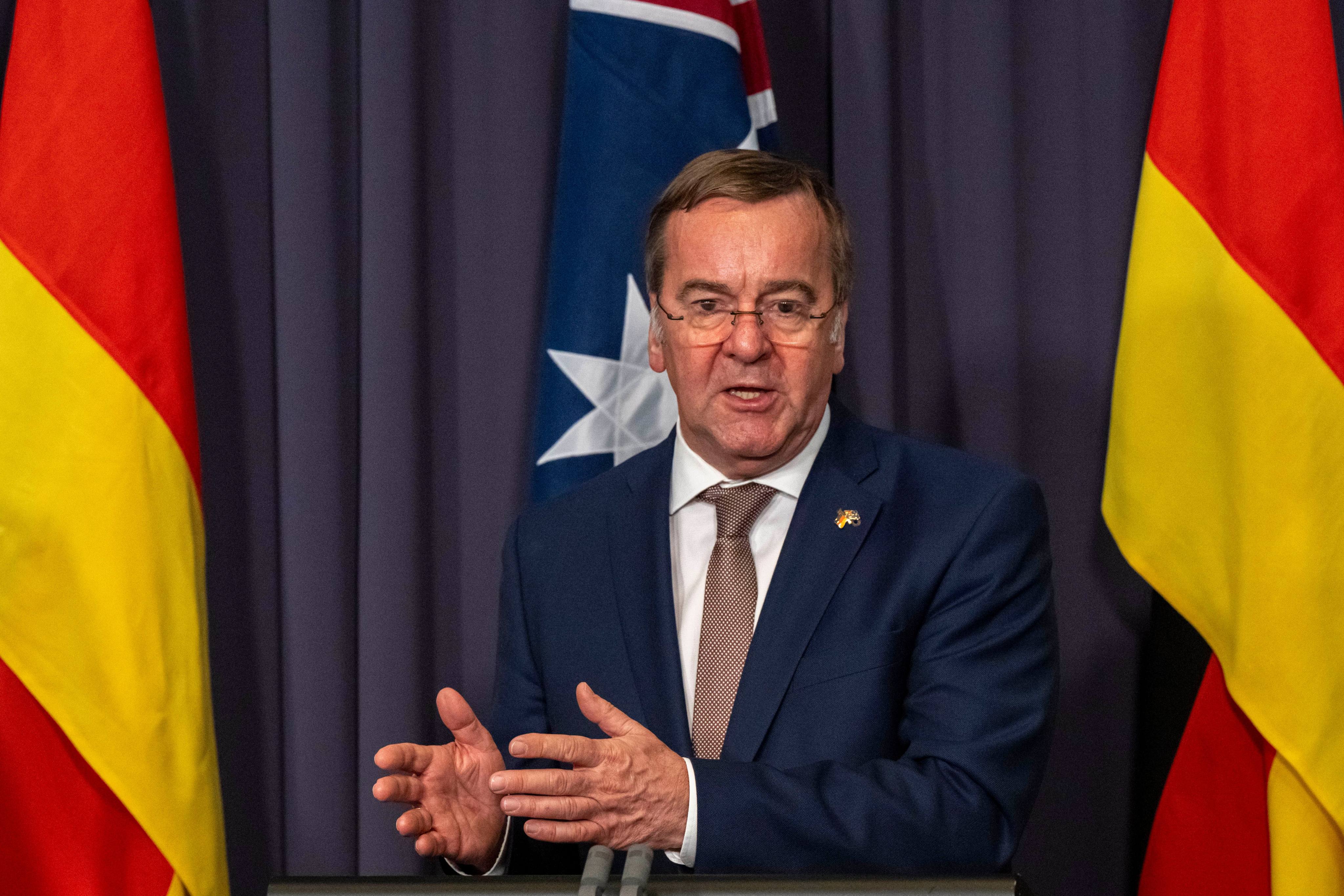
German Defence Minister Boris Pistorius speaks during a press conference with his Australian counterpart Richard Marles following their meeting in Canberra on Thursday.
Photo: dpa Germany’s defence chief has called on the US to honour its security commitments to the Indo-Pacific and signalled that Berlin will keep raising its military presence in the region, while sharing concerns about “dangerous activities” in the South China Sea.
During his visit to Australia, German Defence Minister Boris Pistorius also sounded an alarm over Beijing’s “close” monitoring of Washington and its allies’ management of the Iran and Ukraine conflicts. “To me, one thing is crystal clear.
Without a strong US presence, the Indo-Pacific would be less safe for us and for our allies,” he said during a speech on Thursday at the National Press Club in Canberra.
Pistorius highlighted that “a truly comprehensive European security approach must comprise Indo-Pacific security as well”. “Germany will send a maritime patrol aircraft and parts of a sea battalion to the Indo-Pacific in 2027 and 2028,” he said.
Pistorius said his country would again take part in the Rim of the Pacific Exercise (RIMPAC), the world’s largest biennial international maritime war game, whose next edition is set to take place this year.
And Germany would take part in the Pitch Black 2026 exercise in Australia, which is scheduled for July 20 to August 7, with nine Eurofighters, after the country’s participation in the major biennial international drill in 2022 and 2024, he said.
The German minister expected that those deployments would help “strengthen our relations with a crucial player in the region, the United States”.
His remarks came as US President Donald Trump shifts American foreign policy priorities, elevating the western hemisphere as the dominant geographic focus and raising anxiety among Washington’s allies about the future of US security commitments to them.
Alongside their European counterparts, capitals from Tokyo to Canberra have been increasingly uneasy with a White House that appears ready to leverage trade tariffs against them and demand steep increases in defence burden-sharing.
Stephen Biegun, who served as US deputy secretary of state from 2019 to 2021, argued that for US allies in Asia, the main concern should not be the policies of Washington but rather the timetable of China’s potential moves in the region.
He was speaking at an event hosted by the Lowy Institute think tank in Mel
原文链接: 南华早报