
Japanese combat troops to return to Philippines in ‘significant’ Indo-Pacific defence shift
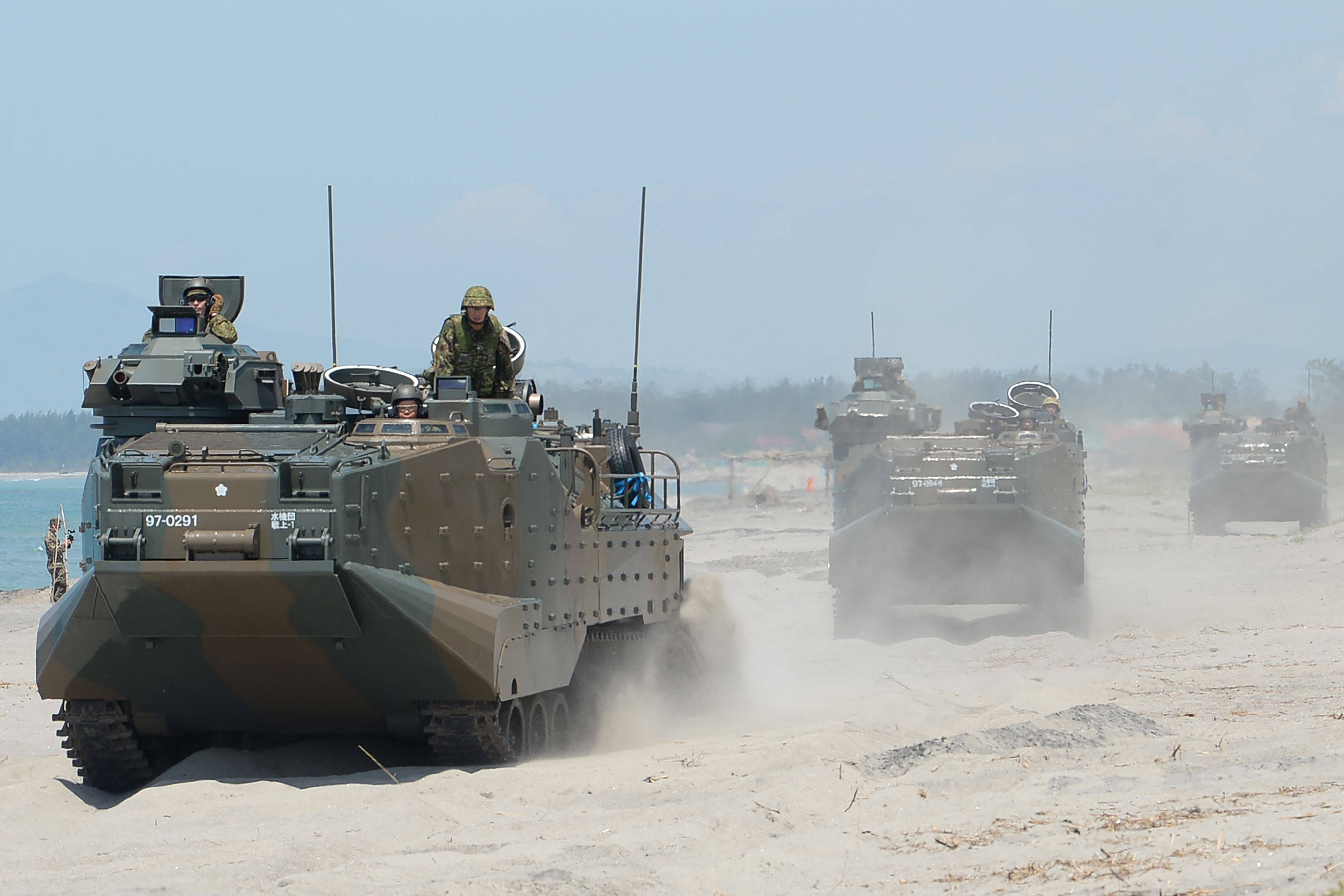
Japan Ground Self-Defence Force personnel on board amphibious assault vehicles take part in a joint landing exercise with Philippine and US troops in San Antonio, Zambales province, in 2018.
Photo: AFP At least 1,000 Japanese armed combat troops will set foot on Philippine soil next month for the first time in 81 years since World War II.
Their return, as part of the joint Philippine-US Balikatan military training drills, also signals a dramatic shift in the development of the Indo-Pacific security architecture from a “hub-and-spoke” strategy to one of multiple, overlapping minilaterals, with the region seen as one undivided theatre, experts say.
Armed Forces of the Philippines Chief-of-Staff General Romeo Brawner Jnr noted the return of Japanese soldiers “is very significant”, during a day-long conference on Tuesday to mark 70 years of diplomatic relations between Manila and Tokyo. “The last time that combat troops from Japan were in the Philippines was in 1945.
Since then, combat troops from other countries were not allowed, specifically from Japan, were not allowed in the country,” Brawner said.
Historians estimate that Japanese forces killed half a million Filipinos during Japan’s three-year occupation of the Philippines. “So that is very significant because back then, we found ourselves on opposite sides of the war,” Brawner said. “But this time, we find ourselves on the same side.
Together with the United States, we will stand together.
These four nations [along with Australia] will come together to exercise defensive operations.” Philippine military chief General Romeo Brawner Jnr and Japan’s General Yoshihide Yoshida have jointly pushed for the “One Theatre Concept” to secure the Indo-Pacific region.
Photo: AP Last December, the armed forces of the four nations signed an agreement in California to “institutionalise” the grouping that Pentagon officials have privately nicknamed the “Squad”.
Brawner said the move was an assurance that more activities would be “under that umbrella” and that there were plans to include countries such as South Korea and India.
He disclosed that he and former military counterpart General Yoshihide Yoshida had jointly pushed for the “One Theatre Concept” to secure the Indo-Pacific region, coining the term OCEAN (One Coordinative Effort Among Nations) for it.
According to Brawner, OCEAN prioritises a holistic and collective approach to defence that also addresses energy and food security.
It will include elemen
原文链接: 南华早报