
Why China’s humanoid robots are still waiting for their ‘ChatGPT moment’
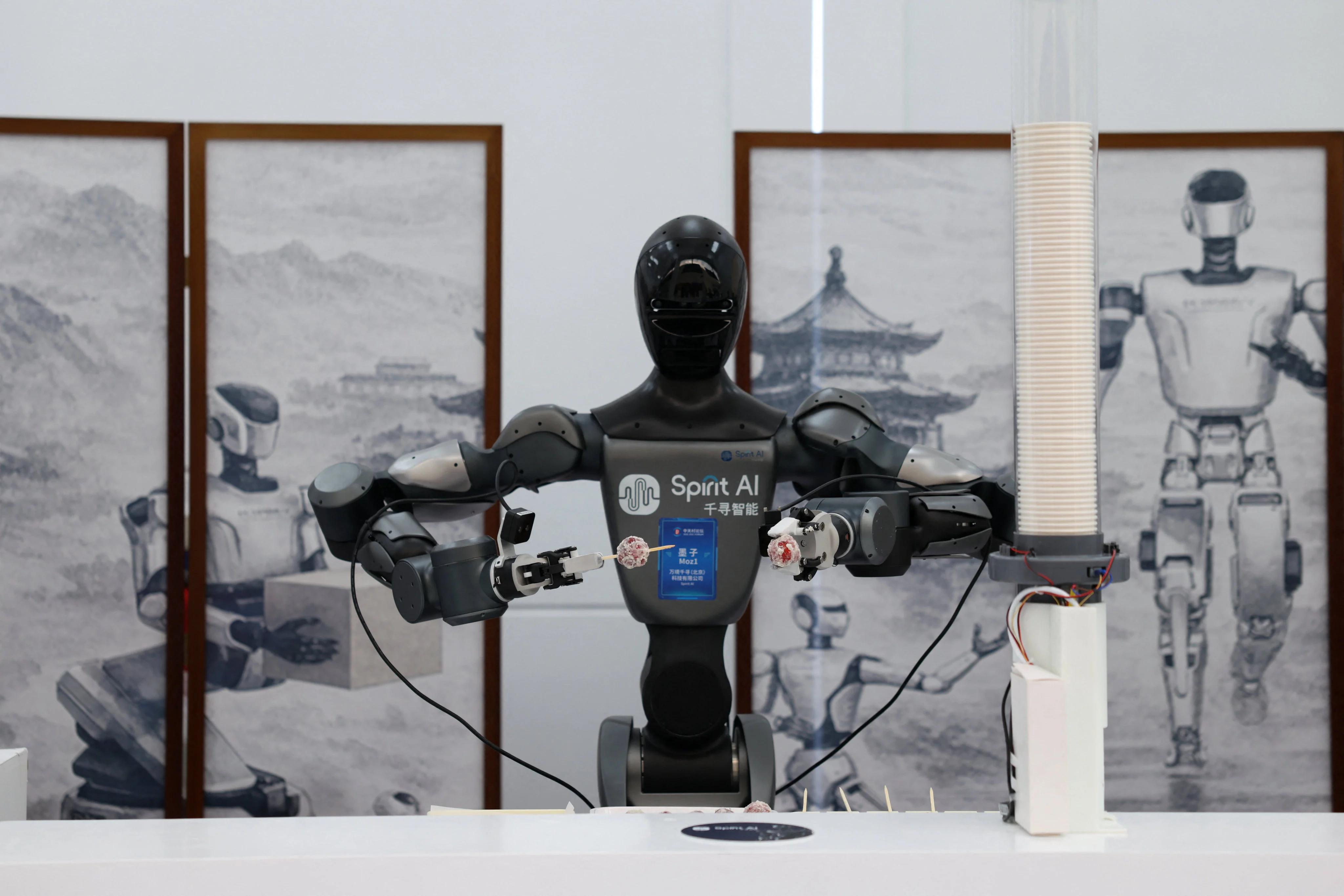
A humanoid robot serves candied hawthorn on sticks at the 2026 Zhongguancun Forum in Beijing, March 25, 2026.
Unlike ChatGPT, the robotics industry has yet to find its sweet spot.
Photo: Reuters A “ChatGPT moment” for China’s humanoid robots – the tipping point at which the technology becomes widely usable – remains years away as persistent challenges in adapting to new tasks and training efficiency continue to hold back the industry, leading experts said on Wednesday at the Boao Forum for Asia in Hainan.
Despite rapid advances in recent years, humanoid robots were still far from large-scale deployment, with both hardware and software limitations yet to be fully resolved, panellists said during a discussion on the sector’s future. “The core issue is that robotics data is extremely high-dimensional, while text data [used to train large language models] is essentially one-dimensional,” said Shao Hao, chief scientist at the robotics lab of Chinese smartphone maker Vivo. “Looking back, deep learning began gaining momentum around 2012, but the breakthrough moment didn’t arrive until around 2019.
The key difference maker was data.” A Kuavo-5W humanoid robot by Leju Robotics passes freshly made coffee to a journalist during a demonstration at the 2026 Zhongguancun Forum, a major annual technology conference in Beijing on March 25.
Photo: Reuters In the robotics industry, references to OpenAI’s “ChatGPT” have become shorthand for the point at which a technology overcomes key technical bottlenecks and achieves mass adoption.
By massively expanding the volume of training data – including large amounts of human-labelled inputs – OpenAI developed models capable of generalising across previously unseen tasks, underpinning ChatGPT’s launch in late 2022.
However, while OpenAI was able to draw on vast, readily available online data at scale, the robotics industry has yet to identify a similarly cheap and reliable source of its own.
Wang Xiaogang, co-founder of SenseTime and chairman of its robotics spin-off Ace Robotics, said the industry had so far accumulated only hundreds of thousands of hours of training data, largely derived from human teleoperation.
This paled in comparison to adjacent sectors such as autonomous driving, which generated millions of hours of data on a daily basis using cutting-edge simulations, he said. “A ‘ChatGPT moment’ for robots will only happen when we move beyond manual data collection methods,” Shao said, estimating that it could tak
原文链接: 南华早报