
Life in Iran illustrates shifting realities amid US-Israel war
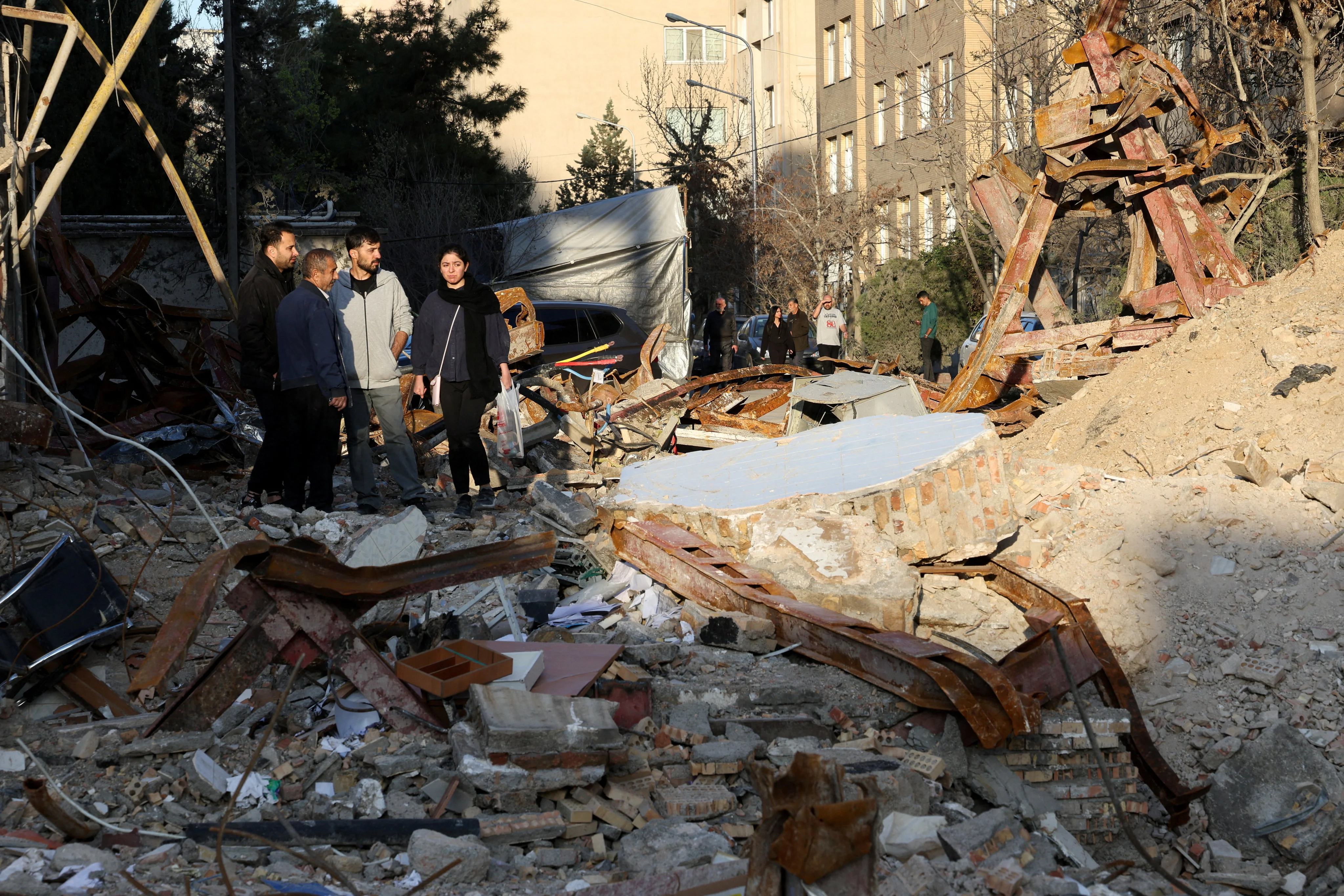
People look at a destroyed building in Tehran, following a strike amid the US-Israeli conflict with Iran, on March 21.
Photo: Reuters On most nights, the sound that defines Tehran is not conversation or traffic.
Instead, it is a distant explosion, a jet overhead, a pause in the rhythm of ordinary life.
A few days ago, that distance collapsed.
An explosion in eastern Tehran, where I live, shattered the windows of our home.
Glass fell across my books and laptop, damaging it beyond repair.
For a moment, the abstract language of conflict became immediate and physical.
And yet, almost as quickly, life resumed.
The city has not stopped functioning.
Shops still open, people go to work, families gather.
However, everything is slightly altered, as if daily life is being lived alongside an awareness that something larger is unfolding just beyond reach.
That awareness shapes even the smallest decisions.
For me, as for many others, the disruption is not only physical but informational.
Internet access has become unreliable to the point of near absence.
I find myself spending parts of the day trying to connect through unstable VPNs, sometimes for just a few minutes, enough to send an email or check headlines.
The gap between external narratives and internal reality is widening.
Within my own circle of family, friends and colleagues, conversations have changed.
A relative recently insisted on buying extra essentials, not because they are unavailable today but because there is no certainty about tomorrow’s prices.
A colleague described adjusting work around brief windows of connectivity rather than fixed hours.
What is striking is not the breakdown but the continuity under strain.
People are not reacting as if everything is collapsing; instead, they are recalibrating daily life.
A cyclist flashes a victory sign near the Persian Gulf Martyrs artificial lake during the Iranian New Year holidays in western Tehran on March 22.
Photo: AP This lived reality contrasts sharply with how the conflict is often framed internationally.
Much of the focus remains on military exchanges, missiles, air operations and tactical developments.
But from within, it is increasingly clear the conflict is no longer defined primarily by battlefield outcomes.
Its effects are felt more directly through infrastructure, markets and economic systems.
In recent weeks, escalation has increasingly targeted energy infrastructure and regional economic nodes across the Persian Gulf.
原文链接: 南华早报