Chinese satellite performs landmark refuelling test in low Earth orbit
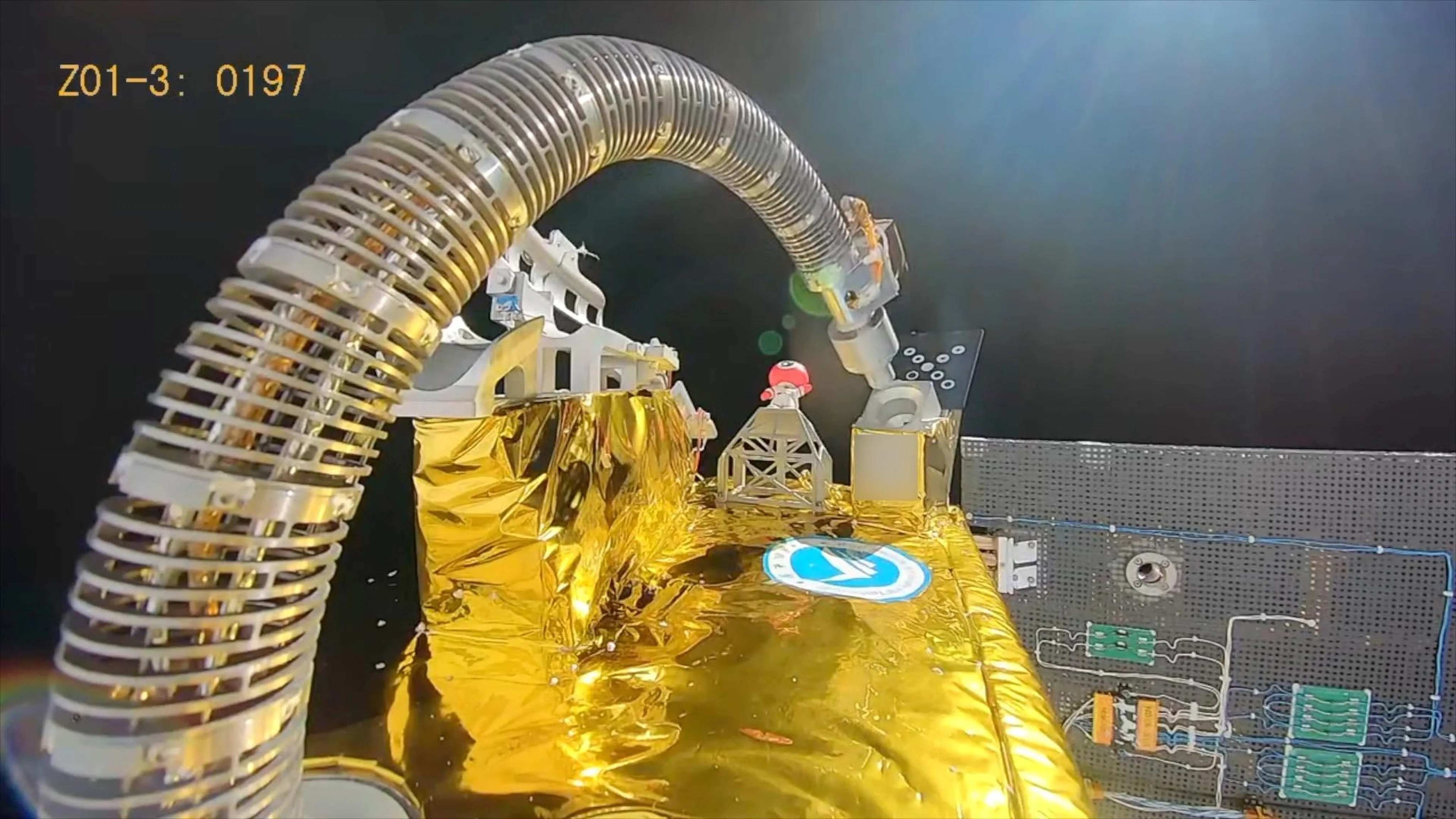
he technology demonstration satellite known as Hukeda-2 has carried out refuelling and compliance control tests with its flexible arm.
Photo: Handout A Chinese commercial satellite has completed a refuelling test in low Earth orbit using a flexible “octopus tentacle” robotic arm, advancing efforts to extend spacecraft lifespans and develop in-orbit servicing abilities.
The Hukeda-2, or Yuxing-3 06, demonstration satellite used its flexible arm to carry out compliance control and refuelling tests after blasting off from Jiuquan in China’s northwestern Gansu province last week, state broadcaster CCTV reported on Tuesday.
The arm can curl, twist and wrap around objects to work in tight, complex spaces, with a nozzle-like tip at one end designed to line up and connect with a target port.
It is made of a series of linked spring-like tubes with motors that pull on cables, bending its joints to guide the tip into place, according to the Tsinghua Shenzhen International Graduate School, which led the arm’s design and development.
It is unclear if the Hukeda-2 docked with another satellite.
To refuel another satellite, the Hukeda-2 would have to dock precisely with a port as both satellites hurtled around Earth at about 27,000km/h (16,800mph), a major challenge that the developers likened to “threading a needle in space”.
The slightest tremor could throw a satellite off position and ruin a docking attempt.
During a thermal vacuum test simulating the extreme temperature swings of space, tiny heat-driven changes in the arm’s materials once sent it into “uncontrolled shaking” inside a giant vacuum chamber, the school said.
The research team fixed the problem after three days of adjusting the control algorithm.
According to US Space Force orbital data, the Hukeda-2 is flying at an altitude of about 530km to 540km in a sun-synchronous orbit – a path that takes it from pole to pole as Earth rotates beneath it.
Jointly developed by Hunan University of Science and Technology and Suzhou Sanyuan Aerospace Technology, the satellite is the first of its kind built outside a state-owned enterprise, CCTV said.
In-orbit refuelling of satellites is an emerging technology aimed at prolonging the life of high-cost space infrastructure.
Last year, China’s Shijian-25 satellite successfully docked with Shijian-21 in geosynchronous orbit to perform a world-first, satellite-to-satellite refuelling test about 36,000km above Earth.
The Shijian-21, launched in 2021 to test space
原文链接: 南华早报