
On Taiwan, Trump reimagines strategic ambiguity to suit his own ends
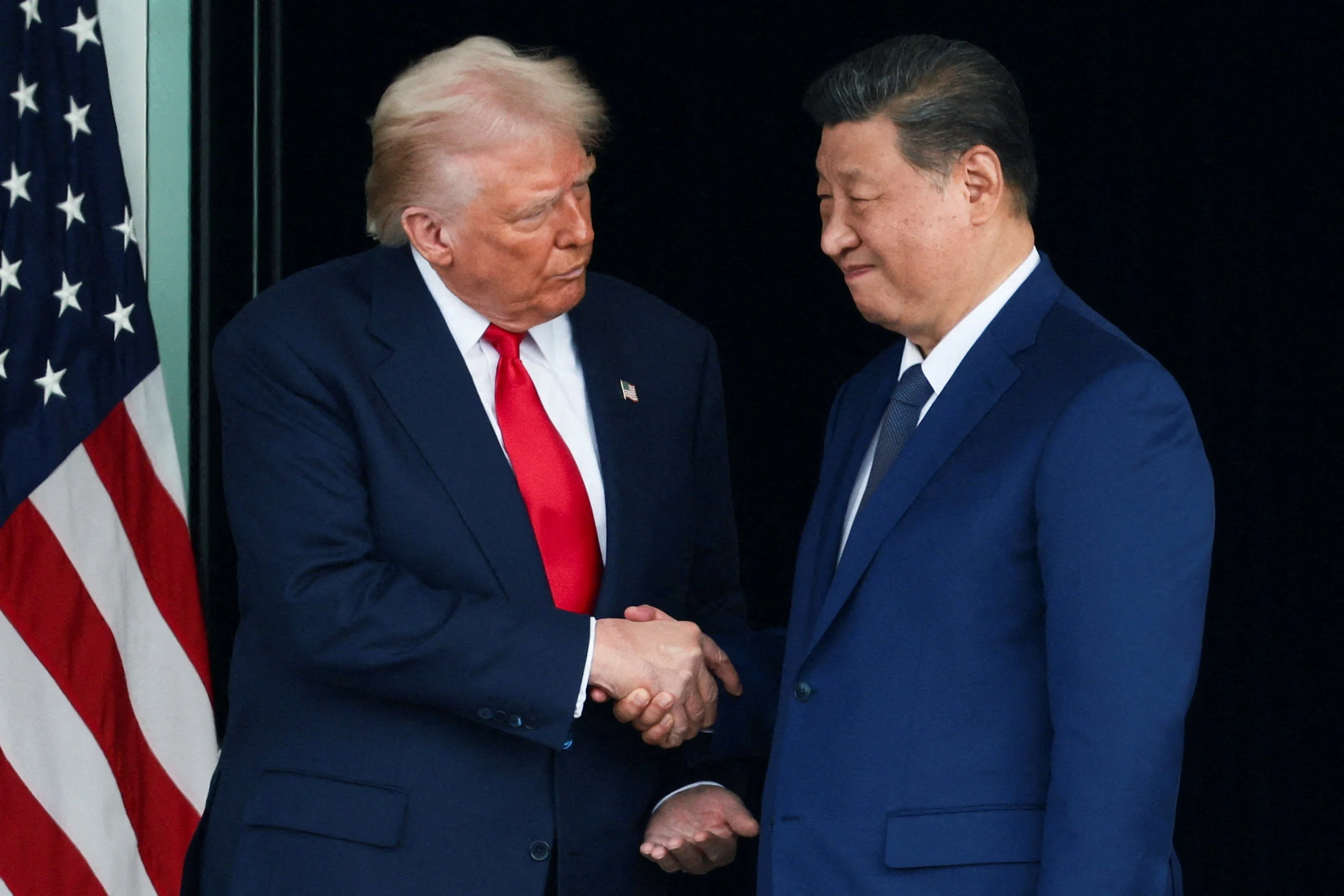
US President Donald Trump and Chinese President Xi Jinping talk after a bilateral meeting at Gimhae International Airport, on the sidelines of the Asia-Pacific Economic Cooperation summit, in Busan, South Korea, on October 30, 2025.
Photo: Reuters Beijing is probably sighing with relief following US President Donald Trump’s postponement of his visit to China for “a month or so”.
Initially, Trump had tried to threaten China for not joining a proposed naval escort campaign in the Strait of Hormuz, but quickly changed his tone after recognising the absurdity of such a demand.
Not even the United States’ closest allies are willing to lend a hand.
However, Beijing is even more frustrated with Washington’s lack of clarity and Trump’s hazy agenda for what he wants to accomplish on his coming visit.
This month’s meeting in Paris, France, between Vice-Premier He Lifeng and US Treasury Secretary Bessent to discuss the detailed agenda apparently yielded little of substance.
Few seem to understand why Trump is unwilling to reveal his hand before his much hyped visit: in fact, his operational style has changed – from traditional strategic ambiguity into one that may perhaps be best understood as “compound strategic ambiguity”.
The fundamental principle of traditional strategic ambiguity is to foster uncertainty – in this case, to deter Taiwan’s reunification by force.
During his first term, Trump primarily employed traditional strategic ambiguity, using the unspoken uncertainty of how the US would react to a military unification of Taiwan.
Traditional strategic ambiguity has long been a US tool for seeking stability in the Taiwan Strait.
However, such a strategy has a singular objective and lacks the operational space to use Taiwan as a bargaining chip.
Thus, it fails to meet the demands of Trump’s preference for making deals.
He once publicly suggested that the one-China policy was meaningless to the US unless it could be used as a bargaining chip for something else.
To compensate for the shortcomings of traditional strategic ambiguity, his team of modern-day West Coast Straussians have proposed a strategy of compound strategic ambiguity, the gist of which was reflected in the US’ 2025 National Security Strategy.
This shift has provided Trump with a new operational approach to summit diplomacy with Beijing, as it frees up room for bargaining for a new deal.
The crux of this approach is not to reveal Washington’s hand before negotiations, thereby deliber
原文链接: 南华早报