Semicon China: AI, advanced packaging set to drive country’s chip industry growth
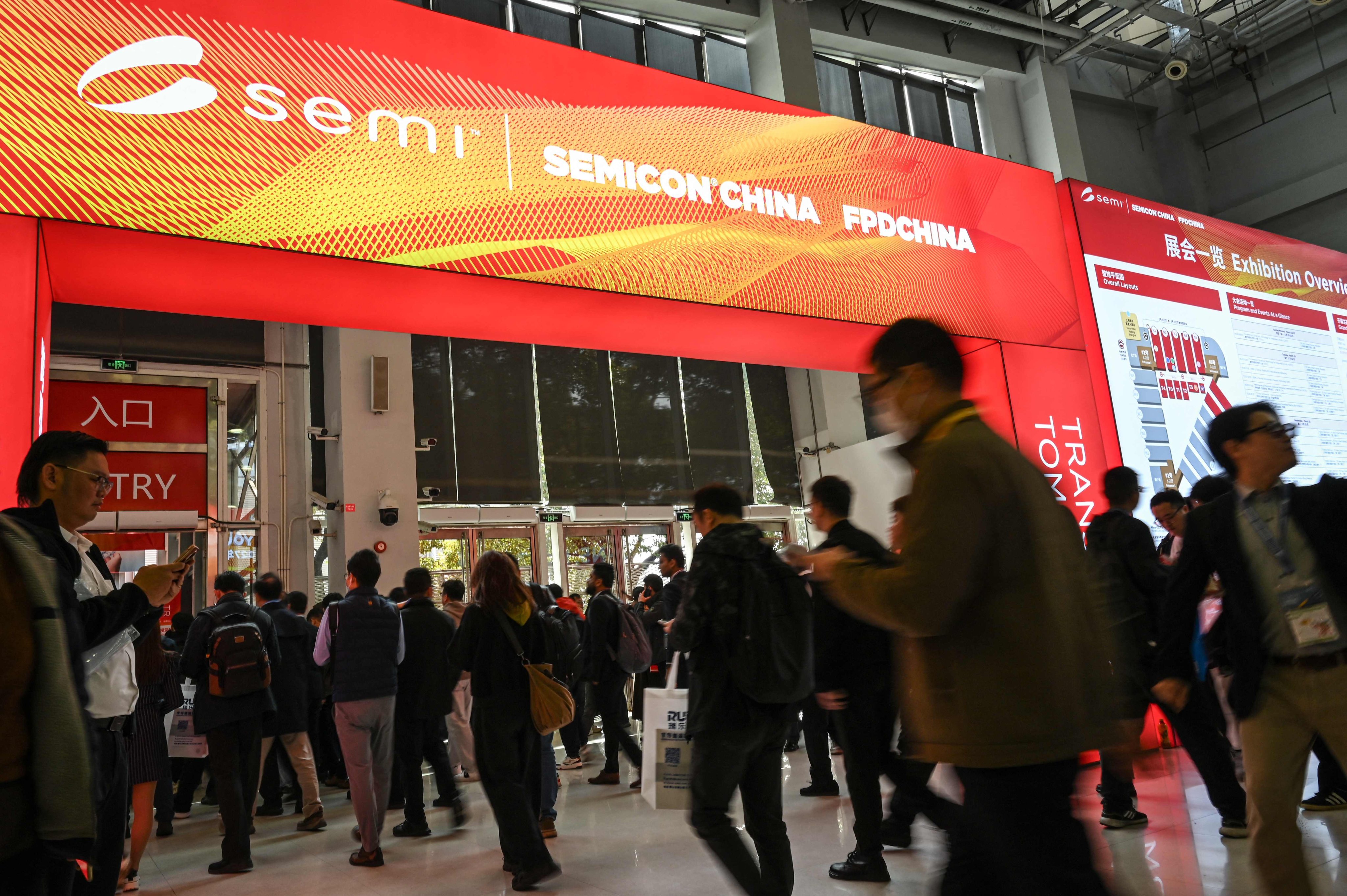
People stream into the Semicon China exhibition in Shanghai on Wednesday.
Photo: AFP Agentic artificial intelligence and advanced packaging technology will be key growth drivers for China’s chip industry in coming years, as the country is expected to increase its share of chipmaking capacity to nearly half of the world’s total by 2028.
According to data revealed at Semicon China, the world’s largest chip industry trade show, China’s share of wafer fabrication capacity for mainstream processes was expected to reach 42 per cent of global capacity by 2028.
That would mark a rapid increase from 32 per cent in 2025, according to Lily Feng, president of SEMI China, the Chinese branch of chip industry association SEMI and the organiser of the event.
The annual trade show, in Shanghai from Wednesday to Friday, expects to welcome more than 180,000 attendees this year, making it the world’s largest professional semiconductor expo, Feng said.
A key factor expected to drive growth in China’s chipmaking capacity will be the adoption of AI agents, a trend highlighted by a few speakers during the opening session of the event on Wednesday.
Such agents – software programs capable of performing complex tasks autonomously – are the latest buzzword in China’s tech community after the rise of OpenClaw, an OpenAI-backed agent framework that has taken the industry by storm. “What makes OpenClaw noteworthy is not only that it is a phenomenal product, but also the crucial fact it revealed that AI agents consume far more computing power than previous formats of AI products,” said Sun Guoliang, senior vice-president and chief product officer at Shanghai-based MetaX Integrated Circuits.
The adoption of AI agents increases the need for computing power used for AI inferencing – the “doing” part of artificial intelligence, where a trained model stops learning and turns its knowledge into real-world results. “Inference is set to accelerate as language models continue to get smarter, smaller, cheaper and more open,” said Mario Morales, vice-president and head of corporate strategy and partnerships at AMD, the US AI chipmaker and smaller rival to Nvidia. “AMD is aligning with the market trends.” The remarks come at a time when China is set to further step up its quest for chip self-sufficiency, especially after Beijing’s latest five-year plan called for breakthroughs in critical technologies across the semiconductor value chain.
People walk through a booth at the Semicon China exh
原文链接: 南华早报